
Case StudyADAC · Connected vehicle
The car delivers data. We make it usable.
ADAC Smart Connect, built and run by us since 2021. From the telematics dongle to manufacturer data that now reaches roadside assistance.
- 99.97%Availability over 3 years of trial operation
- 15MData transmissions a day
- Since 2021Development and operations
A connected car platform for ADAC. Built and operated since 2021.
OpenResearch built ADAC Smart Connect on Microsoft Azure from scratch and has been developing the platform ever since: the Smart Connect app for members, the SCOPE operations console and a backend that takes dongle and manufacturer data all the way to roadside assistance.
At a glance:
Client

Period
Since July 2021
Technology
Azure, .NET 8, Terraform
01Starting point
No platform. Just a goal.
In July 2021, there was no platform, just the goal of making vehicle data useful for members and roadside assistance.
Modern vehicles and connected devices send data continuously. Turning that into services takes a platform that reliably receives and processes these events and passes them on to apps. It started with telematics dongles in the OBD port and an app for members. Today the data also comes directly from the vehicle manufacturer.
02Approach
Invent little. Know a lot.
Domain knowledge is often underestimated. It significantly reduces schedule risk and, in our view, is the cornerstone of successful projects.
We relied on dependable, forward-looking technologies we knew well, and on experience from connected-vehicle projects since 2016, from a complete scooter-sharing platform to event-driven processing of IoT device data.
Domain knowledge since 2016
Experience is the best schedule insurance.
Step by step since 2021:
2021
Smart Connect kick-off
Sprint 0 in July. Telematics dongles connected, Azure infrastructure, an operations panel for subscriptions and shipping. Production-ready by year end after a pentest.
2022
Expansion into trial operation
The operations panel becomes SCOPE. Trips with eco and safety scores, alarm mode, remote diagnostics from the app, GDPR services. Rollout to test users.
2023
Automated diagnostics
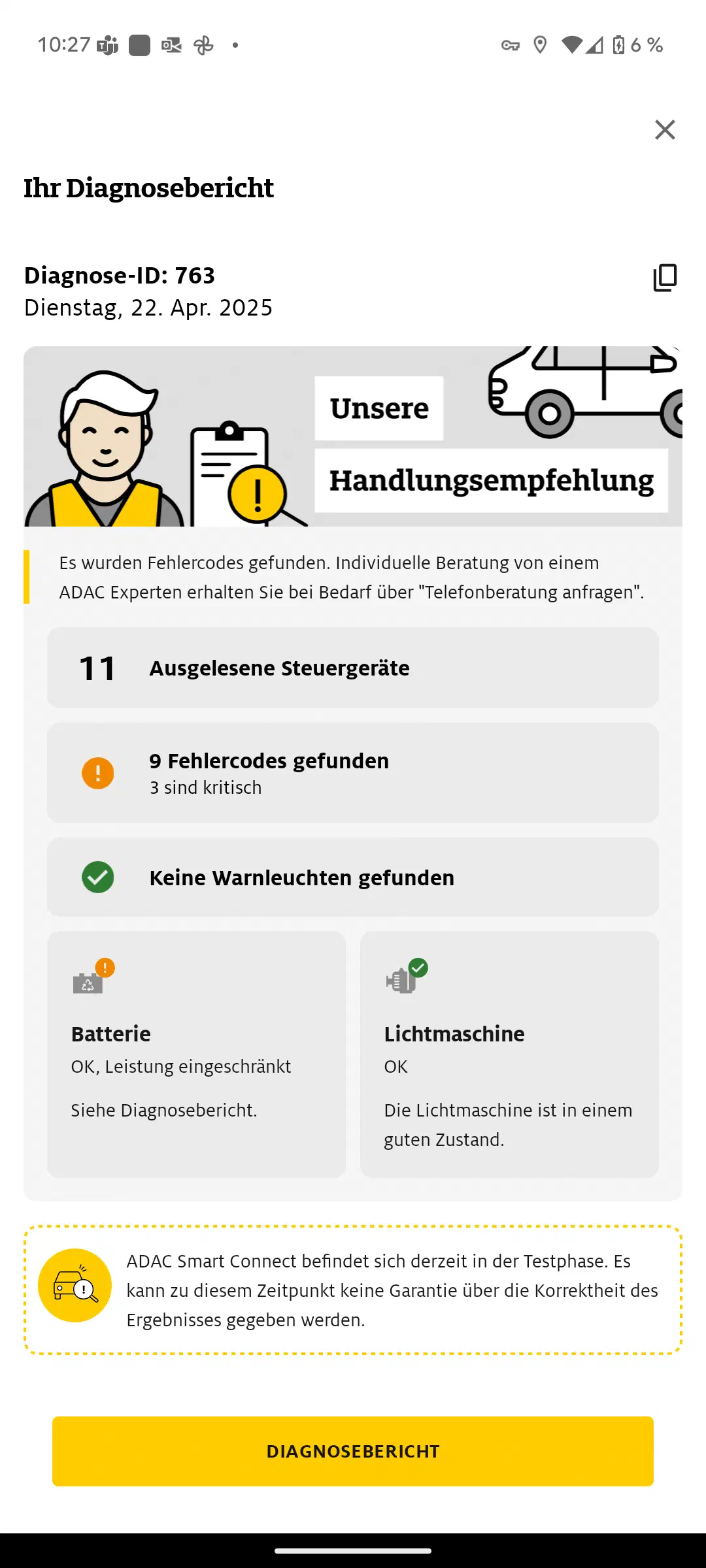
Members can start the Automated Member Diagnosis (AMD) in the app. Once all control units have been read, the result is available immediately. Data science work begins in the project. The proof of concept goes into trial operation.
2024
Stable operation
A fixed release, support and test process, .NET 8. Maintenance reminders, battery warnings, an explainable safety score. First manufacturer data is evaluated.
2025
Manufacturer data instead of dongles
OEM proof of concept 1.0 and 2.0 across several manufacturers. Onboarding of manufacturer connections in the app, backend and SCOPE. Data quality measures, another pentest.
2026
Roadside assistance pilot
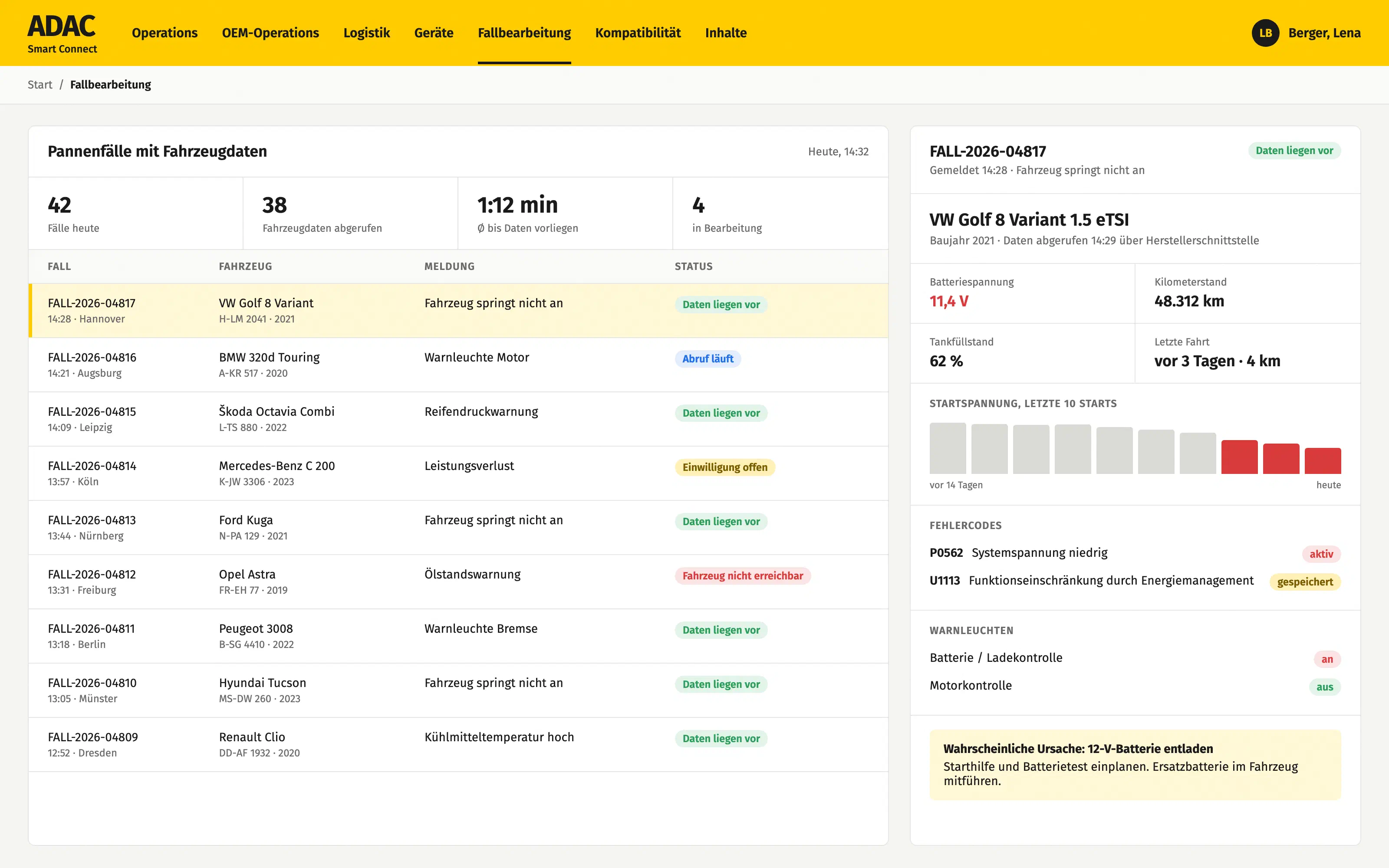
Reactive use case pilot: the backend receives breakdown data, retrieves vehicle data and assigns it to the case. Handling takes place in SCOPE.
03Decisions
What we chose.
Four decisions: risk out, speed in.
Each one served the same goal, and each had an obvious alternative that we deliberately rejected.
What we chose, and why:
Cloud
Microsoft Azure
The team knew Azure very well. Familiarity beats theory, and it still holds today.
Infrastructure
Terraform
Instead of manual environments: repeatable and traceable.
Data
Lambda architecture
Instead of separate systems: one data foundation, two speeds.
Data source
Open to manufacturers
Instead of being tied to the dongle: vehicles also connect directly via the manufacturer interface.
04Solution
Real time for the apps. The same data for BI.
Vehicle data is processed the moment it arrives: on average more than 1,500 data points per vehicle per day.
Members see it in the Smart Connect app, and ADAC works with it in SCOPE. In parallel, it lands in long-term analytical storage, where data science looks for patterns for roadside assistance.
Three interfaces, one core:
Smart Connect app
For members
Mileage, fuel, battery, trips and remote diagnostics with recommended actions.
SCOPE
For operations
Subscriptions, shipping, devices, compatibility and case handling for roadside assistance.
Backend on Azure
For everything in between
Dongle and manufacturer data, GDPR services, deletion and archiving concept.
Result
- 99.97%.Availability over three years of trial operation. The requirement was 98.5%.
- 15M.Data transmissions a day across 10,000 vehicles.
- 8 TB+.Vehicle data collected since 2021.
- 100M+.Files in long-term analytical storage.
06Collaboration
Who did what.
Clear roles from the start.
ADAC owns the product and brings domain expertise and roadside assistance; OpenResearch brings architecture, delivery and operations. One team since 2021.
OpenResearch
Architecture & delivery
- Platform architecture
- Azure with Terraform
- Stream and batch processing
- Provisioning for BI
- Smart Connect app
- SCOPE with case handling and reporting
- Operations, release and support process
ADAC
Product & domain
- Product ownership
- Target vision and functional requirements
- Roadside assistance process and case handling
One team. Two roles.

Your contact · Initial call · Free · online
30 minutes.
An honest assessment.
Philipp listens and tells you honestly what’s realistic.
What happens next:
An honest assessment with Philipp. Book directly above.
We work on your real question with the team that would later build it. You leave with a sketch of the possible way forward.
Request an intro session- Discovery & scopingHalf a day
A shared goal, prioritised features and a realistic MVP with clear next steps.
- Modernisation & legacy assessmentHalf a day
Rebuild or refactor? Surface hidden dependencies and plan a low-risk path.
If it becomes a project, the workshop fee is fully credited.
Delivered in this project with.
4 services, one team:




More case studies.
Real projects, real numbers:
 01ÖAMTC Tourfold740,000+ call-outs. One dispatch system that cannot fail.Read the case study
 02ÖAMTC AppFast help, whatever happens.Read the case study
 03RailPaper then. Digital now.Read the case study
 04Porsche AustriaRoadside assistance without manual handovers.Read the case study
 05Bestattung Wien10,000+ cases a year. With dignity, without phone chains.Read the case study
 06DRVNSame function. One sixteenth of the cost.Read the case study
Good to know.
What is a connected-vehicle platform?
A connected-vehicle platform receives the data that vehicles and built-in devices send continuously, processes it and makes it available to applications, such as member apps, breakdown services or analytics for the business.
Why did OpenResearch choose Microsoft Azure for ADAC?
Because the team knew Azure very well. With such a tight timeframe, familiarity with the platform mattered more than any theoretical alternative; it’s what made the pace possible.
What is a lambda architecture?
A data architecture with two paths: a stream path processes events immediately so apps can react in real time. A batch path processes the same data in bulk for analytics and business intelligence. The result is one data foundation for two speeds.
How long has OpenResearch been working on ADAC Smart Connect?
Since July 2021. After sprint 0, the first version of the Smart Connect app was pentest-hardened and production-ready by year end. Since then, OpenResearch has kept developing and running the platform, through trial operation, automated diagnostics and manufacturer data to the roadside assistance pilot in 2026.
How available is the ADAC Smart Connect platform?
Over three years of trial operation, availability was 99.97%. The pilot project required 98.5%.
Does the platform work without a dongle?
Yes. Since 2025, vehicles have also been connected directly via the manufacturer’s interface, for several manufacturers. The app, backend and SCOPE have their own onboarding for manufacturer connections.
Does OpenResearch build such platforms for other mobility providers?
Yes. Since 2016, OpenResearch has built connected-vehicle and IoT systems, from a complete scooter-sharing platform to event-driven processing of device data. We bring that domain knowledge to every new project.